

I started my reading about Grosseteste and his scientific works with ‘The Dimensions of Colour’ on the De colore. Although when reading the translation I couldn’t picture Grosseteste’s model in my head, I was baffled by its complexity and sophistication. Such an abstract account of the phenomenon of colour was certainly not what I expected from a medieval scholar and theologian, who later in his life even became bishop. Furthermore, I found that the critical edition and translation broadened my horizon not only with respect to the content of the treatise, but also concerning the challenge of establishing in the first place what the original content was. As I said, I know embarrassingly little about history and the methods involved in the discipline, and it was very interesting to see how the multitude of diverging manuscripts can be a caveat to appreciating the coherence of medieval scientific thought.
The third chapter on the intellectual context of the treatise, its terminology, its relationship with Grosseteste’s other writings, and the sources he was influenced by, helped in getting more of an understanding of what it was that Grosseteste envisaged. However, it was only through the functional analysis that I felt I grasped Grosseteste’s idea of colour. It seemed that I had found his treatise so difficult to understand because he was describing a geometric model verbally. 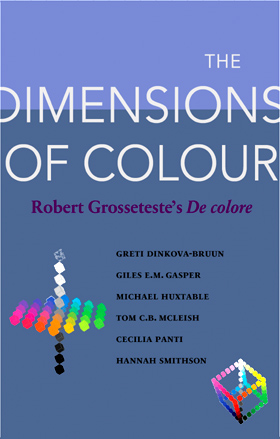
Ulrike